Lessons in practical electricity; principles, experiments, and arithmetical problems, an elementary text-book (1903)
Swoope, Coates Walton. [from old catalog] · New York, D. Van Nostrand company · leaf 165
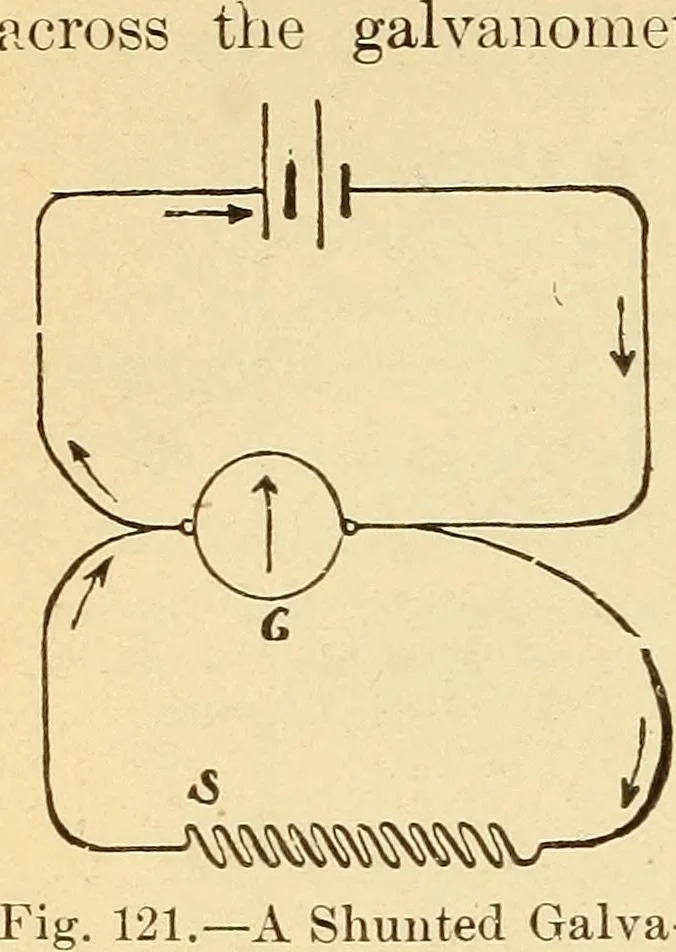
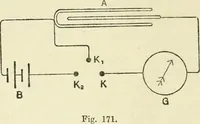
galvanometer. Any galva-nometer (ammeter- or voltmeter) may, therefore, have itsrange of indication increased by shunting it.Let G = galvanometer resistance;S = shunt resistance;C = total current in the joint circuit;Cg = currrent in the galvanometer circuit.The multiplying power of a shunt is the… … -A Shunted Galva-nometer. of the resistances, GC Thus or S, bears to the shunt resistance.G4-S Cgf S S 1. To Find the Multiplying Power of a ShuntedGalvanometer: Divide the galvanometer resistance by the resistance of the shuntand add one to the quotient P Multiplying power cf a shunt (n) =q- + 1 .…
Electricity · Magnetism
Internet Archive · Library of Congress · Public Domain Mark 1.0. Free to use for anything.